Bloody Bullecourt by David Coombes
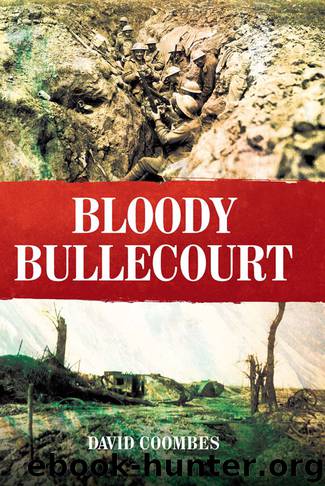
Author:David Coombes
Language: eng
Format: epub
Tags: HISTORY / Military / World War I
ISBN: 9781526713452
Publisher: Pen and Sword
Published: 2017-10-30T04:00:00+00:00
Considering the celebrated reputation of the 4th Australian Division and its leadership, senior German officers were well satisfied with their achievement, most noticeably the large number of prisoners taken. A later British report highlighted ‘the German elation at the defeat of the 4th [Australian] Brigade. War Office records … show they specially feared our [4th] Brigade, and that their front line troops were always warned when the 4th Brigade was opposite them. Also that there was a reward of 1,000 marks for each Colonel of the Brigade and a larger one for the Brigadier General dead or alive. That they knew all these by name was proved to our prisoners captured at Bullecourt.’46
***
The First Battle of Bullecourt witnessed some of the most savage fighting in an already savage war. This battle deserves to rank alongside Gallipoli, Fromelles and Pozieres in the Australian national consciousness. Yet it has largely been forgotten. Like the three previous battles, Australian soldiers overcame enormous odds to secure what, at best, could be labelled a Pyrrhic victory. Fighting their way into the Hindenburg Line, the Australians achieved a short-lived triumph. Following their withdrawal, men from the 4th Australian Infantry Division never recovered from the shock of the fiasco at Bullecourt. They never stopped blaming senior British officers for the poor planning and tank crews for lack of support during the battle. Perhaps they also needed to look more closely at the performance of the Australian artillery and a number of their own senior and, indeed junior officers in the field, where at least some blame should be apportioned.
However, Gough’s blunders stand out. The infantry plan, in which artillery was to play a part, was completely distorted by Gough’s unexpected, badly timed and ill-considered eagerness to use tanks. Twelve tanks, providing all were available to lead off the attack, were hardly sufficient even along the narrow front. This overly ambitious arrangement was totally without precedent. Little wonder that Australian soldiers in France were disillusioned with tanks and that it took more than a year for these men to regain confidence in this new weapon.
While neither Birdwood nor White sufficiently championed the interests of their men, Gough’s change of plan handicapped the Australian commanders. The cancellation of the artillery barrage in favour of the use of tanks undermined those plans already in place. Yet, somewhat ironically, it is far from certain that a preliminary barrage would have proven effective due to the shortage of heavy artillery and insufficient quantities of shells armed with the instantaneous fuse necessary to cut through wire.
***
Quite simply, too much was expected of Australian and British troops in a combined attack alongside largely untried tanks. Apart from the lack of artillery support, other issues also contributed to the tragedy. First, the attack was on too narrow a front and, more significantly, through a re-entrant, allowing the Germans to maximise their machine-gun fire from three sides. Second, intelligence reports failed to recognise that, when Australian troops managed to fight their way into the OG1 trenches,
Download
This site does not store any files on its server. We only index and link to content provided by other sites. Please contact the content providers to delete copyright contents if any and email us, we'll remove relevant links or contents immediately.
| Africa | Americas |
| Arctic & Antarctica | Asia |
| Australia & Oceania | Europe |
| Middle East | Russia |
| United States | World |
| Ancient Civilizations | Military |
| Historical Study & Educational Resources |
The Radium Girls by Kate Moore(12036)
100 Deadly Skills by Clint Emerson(4932)
Rise and Kill First by Ronen Bergman(4797)
The Templars by Dan Jones(4695)
The Doomsday Machine by Daniel Ellsberg(4493)
The Rape of Nanking by Iris Chang(4224)
Killing England by Bill O'Reilly(4008)
Stalin by Stephen Kotkin(3973)
Hitler in Los Angeles by Steven J. Ross(3949)
12 Strong by Doug Stanton(3554)
Hitler's Monsters by Eric Kurlander(3352)
Blood and Sand by Alex Von Tunzelmann(3207)
The Code Book by Simon Singh(3197)
Darkest Hour by Anthony McCarten(3137)
The Art of War Visualized by Jessica Hagy(3014)
Hitler's Flying Saucers: A Guide to German Flying Discs of the Second World War by Stevens Henry(2759)
Babylon's Ark by Lawrence Anthony(2686)
The Second World Wars by Victor Davis Hanson(2529)
Tobruk by Peter Fitzsimons(2521)
